
Crazy Time Rules: Bonus Round and Payout Explained with Wheel Mechanics
Authored by metapayglobal.io, 09-07-2026
A single spin on Crazy Time can turn a $1 bet into thousands of dollars, but the difference between a modest win and a life-changing payout comes down to understanding four bonus games, eight betting segments, and a multiplier system that compounds faster than most players expect. The wheel looks simple from a distance - a giant vertical disc divided into colored segments - yet the mechanics underneath it involve a physical device, a random number generator for certain multipliers, and four distinct bonus rounds each with its own payout logic.
Most newcomers place bets based on gut feeling rather than genuine knowledge of Crazy Time rules, and that gap in understanding is exactly what separates casual players from those who consistently make informed decisions. Before placing real money on the table, it helps to study a detailed breakdown of crazy time a rules, since the format rewards players who know which segments carry realistic odds and which ones exist mainly to build suspense. This distinction matters because the wheel's 54 segments are not evenly weighted, and the payout structure reflects that imbalance deliberately.
This piece breaks down every mechanical and mathematical component of the game - from the base wheel layout to the four bonus rounds, from payout multipliers to the betting strategies that align with how the game actually behaves. The goal is practical clarity, not hype.
How the Crazy Time Wheel Is Built
The physical wheel sits at the center of a televised studio format, spun by a live host in front of cameras. Understanding its layout is the foundation for everything else in Crazy Time game rules, because every bet placed corresponds directly to a segment on this wheel.
Segment Distribution and Numbers
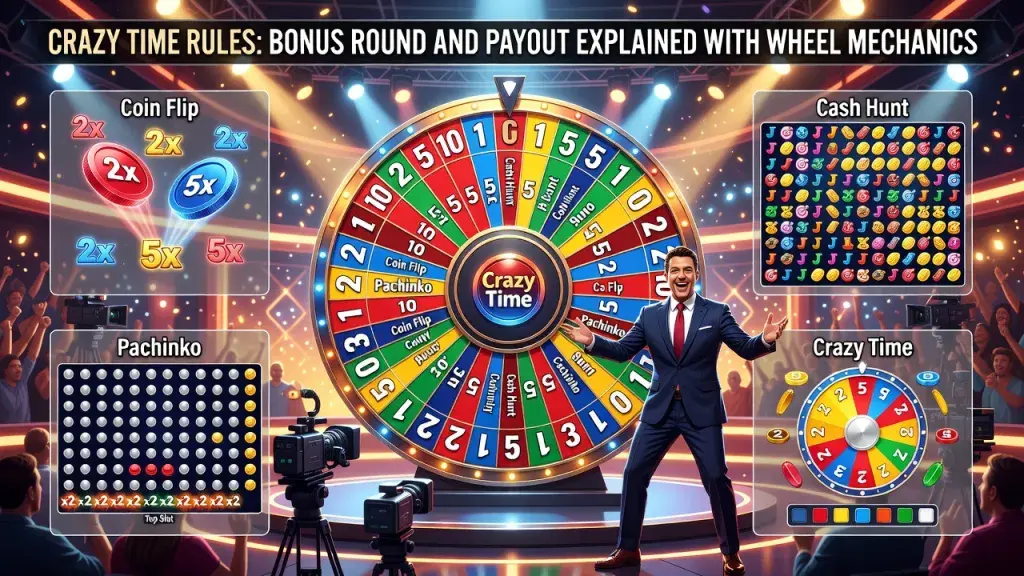
The wheel contains 54 segments total. Forty-five of these are numbered betting spots: 1, 2, 5, and 10, repeated multiple times across the wheel. The remaining nine segments are reserved for the four bonus games - Coin Flip, Cash Hunt, Pachinko, and Crazy Time - with Crazy Time itself appearing only once, making it the rarest and most valuable segment to land.
Why Segment Frequency Matters
Frequency directly determines probability. The number 1 appears far more often than the number 10, which means betting on 1 offers a higher hit rate but a lower payout per win. Betting on 10 or on the bonus segments offers the opposite trade-off: rare hits, but payouts that can multiply a wager dramatically. This inverse relationship between frequency and reward is the core logic behind every serious approach to Crazy Time payout rules.
The Role of the Wheel Mechanics in Fair Play
Crazy Time wheel mechanics rely on a physical spin combined with a verified random outcome system, ensuring no segment is more likely to land based on anything other than its physical presence on the wheel. This is why the payout table is fixed and known in advance - the randomness comes from the spin, not from adjustable software odds.
Core Betting Options and How They Work
Before any bonus round begins, players place their bets on one or more of the eight available options displayed on the betting table.
Number Bets: 1, 2, 5, and 10
These four options form the backbone of standard play. A win pays out at odds matching the number itself - landing on 5 pays 5 to 1, landing on 10 pays 10 to 1. These bets can be combined in any proportion, letting players balance high-frequency, low-reward bets against rarer, higher-paying ones.
Bonus Segment Bets
Players can also bet directly on any of the four bonus games. If the wheel lands on a segment matching that bet, the player advances into the bonus round with their original stake, and the round's outcome determines the final multiplier applied to that stake.
Combining Bets for Balanced Exposure
Experienced players rarely bet on just one segment. A common approach splits stakes across two or three numbers plus one bonus game, spreading risk while keeping a chance at a large multiplier alive. This is less about superstition and more about managing variance intelligently.
- Betting only on 1 and 2 produces frequent small wins with low volatility.
- Betting on 10 and Crazy Time produces rare but potentially massive payouts.
- Mixed betting across three or four segments balances frequency and reward.
Crazy Time Bonus Round Rules Explained
The four bonus rounds are what set this game apart from simpler wheel formats. Each one has distinct mechanics, and knowing them changes how a player should approach betting decisions before the wheel even spins.
Coin Flip
Two coins appear on screen, one red and one blue, each carrying a randomly generated multiplier. The coin flips, and whichever side lands face-up determines the winning multiplier applied to bets on that segment. It's the simplest of the four bonus rounds, with no player interaction beyond watching the outcome.
Cash Hunt
A grid of 108 symbols appears, each hiding a multiplier value. The player selects one symbol, and a shooting-gallery style animation reveals the multiplier underneath. This round has a wider range of potential outcomes than Coin Flip, since the hidden values vary more broadly across the grid.
Pachinko
A vertical board with pegs and multiplier slots at the bottom is used here. A puck drops from the top and bounces unpredictably before settling into one of the slots. One special feature: if the puck lands in a "double" slot, all values on the board double before the puck's final position determines the actual payout - this can escalate quickly.
Crazy Time (the Bonus Game)
The flagship bonus round uses a large 3D wheel with four colored segments - yellow, red, blue, and green - each tied to a different range of multipliers. Players are prompted to shout out or select a color before the wheel spins, adding an interactive layer entirely unique to this round. This is where the highest documented multipliers in the game have historically occurred, making it the most anticipated of the four.
Crazy Time Payout Rules and Multiplier Mechanics
Payouts in this game are not fixed the way they are in a standard roulette wheel. Multipliers introduce a layer of variability that rewards patience and timing as much as pure luck.
How Base Multipliers Are Calculated
Every bonus round begins with base multiplier values assigned to each segment or slot. These values are randomly generated within a defined range before the round starts, meaning no two bonus rounds carry identical starting multipliers.
Top Slot Multiplier Boosts
Before the main wheel spins, a separate "Top Slot" reveals two multipliers connected to specific segments on the wheel. If either boosted segment lands during the spin, or is later reached through a bonus game, the payout for that outcome multiplies further - sometimes doubling or tripling an already substantial win.
Cumulative Multiplier Effects
In rounds like Pachinko, doubling slots can stack, meaning a single drop can result in a multiplier climbing several times over before the puck settles. This cumulative effect is what produces the game's most dramatic payout swings and explains why some rounds generate outcomes far beyond what a simple flat-rate game could offer.
Strategic Approaches Based on the Rules
Knowing the mechanics is only half the equation - applying that knowledge to betting decisions is where strategy comes into play.
Conservative Betting Patterns
Players focused on steady, smaller wins typically concentrate bets on the number 1 and number 2 segments, accepting lower payouts in exchange for more frequent hits and reduced volatility.
Aggressive Betting Toward Bonus Rounds
Those chasing larger multipliers often place the bulk of their stake on the Crazy Time bonus segment itself, accepting long stretches without a win in exchange for the possibility of a substantial multiplier when the segment finally lands.
Bankroll Management Within the Rules
Because payout swings can be extreme, setting a fixed session budget and win/loss limits before playing is far more effective than adjusting strategy mid-session based on recent outcomes, which tend to create false patterns in a genuinely random system.
Frequently Asked Questions
What is the rarest segment on the Crazy Time wheel?
The Crazy Time bonus segment itself appears only once among the 54 total segments, making it statistically the rarest outcome on the wheel and the reason its potential payouts tend to be the highest of the four bonus rounds.
Can the multiplier value change during a bonus round?
Yes, in rounds like Pachinko the multiplier can increase mid-round if the puck lands on a doubling slot, and in Crazy Time the Top Slot boost can apply retroactively if a boosted segment is reached during the round.
Is there a way to predict which bonus round will hit next?
No. Each spin is independent, and the physical randomness of the wheel combined with verified random number generation for multiplier values means past outcomes have no influence on future spins.
Which betting option offers the best balance between risk and reward?
Many experienced players split stakes between the number 2 segment and one bonus round, since this combination provides reasonably frequent small wins while keeping exposure to a large multiplier alive without overcommitting the entire bankroll.
Why do some rounds show two different multipliers before the wheel spins?
Those two values come from the Top Slot feature, which randomly assigns multiplier boosts to two segments before each spin. If the wheel lands on either boosted segment, or a bonus round reaches that value, the payout for bets on that segment increases accordingly.
Does betting on more segments at once increase overall winning chances?
Spreading bets across multiple segments increases the frequency of small wins but does not change the underlying odds of any individual segment. It simply redistributes risk rather than improving the mathematical probability of landing a specific high-value outcome.