
When to Buy Insurance in Blackjack: Correct Strategy, Odds, and Payout Calculations
Authored by metapayglobal.io, 12-08-2026
A player who takes insurance every time the dealer shows an ace will lose money over the long run, guaranteed. That's not a matter of opinion or bad luck - it's arithmetic. Yet insurance remains one of the most misunderstood side bets at the table, tempting even disciplined players into decisions that quietly drain their bankroll.
The confusion isn't surprising. Insurance sounds protective, almost sensible - a way to hedge against the dealer's blackjack when you've got a strong hand of your own. Dealers offer it calmly, as if it's a routine courtesy. But the math behind the bet tells a very different story, one that depends entirely on card composition and count, not intuition. For a deeper breakdown of the mechanics behind the offer itself, this explanation of when to take insurance in blackjack lays out the decision points dealers rarely explain at the felt.
This piece breaks down the real numbers behind the bet - the payout structure, the probability shifts that occasionally make insurance profitable, and the specific circumstances separating a correct call from a costly habit. By the end, you'll know exactly when to buy insurance in blackjack and, more importantly, why the answer is "almost never" for the vast majority of hands you'll play.
What Insurance Actually Is in Blackjack
The Mechanics of the Side Bet
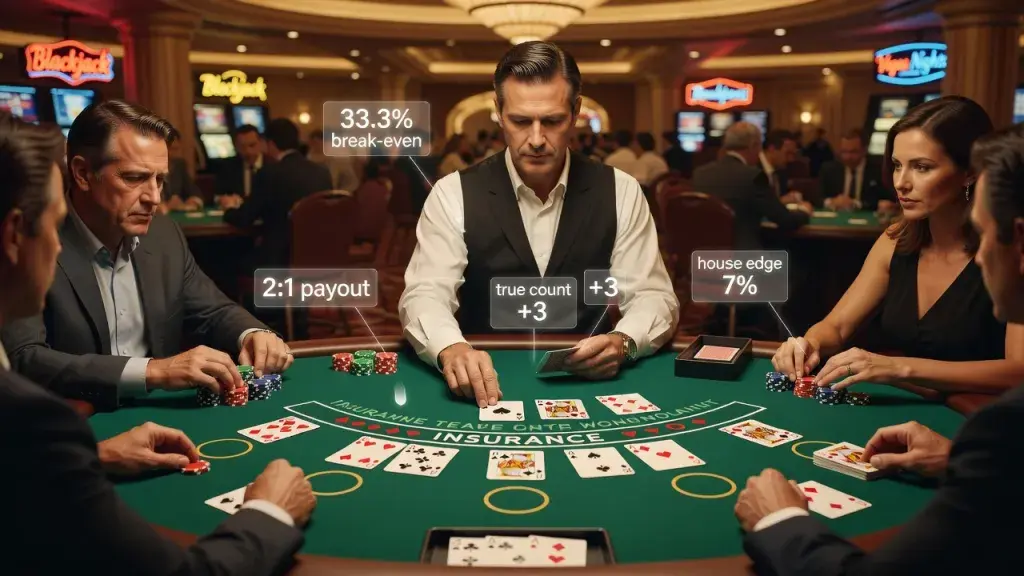
Insurance activates only when the dealer's upcard is an ace. Before checking their hole card, the dealer offers every player at the table the chance to place a side bet worth up to half their original wager. If the dealer's hidden card turns out to be a ten-value card - a ten, jack, queen, or king - completing a blackjack, the insurance bet pays 2 to 1. If the dealer doesn't have blackjack, the insurance bet loses, regardless of what happens with the main hand afterward.
Why It's Technically a Side Bet, Not a Hedge
Casinos frame insurance as a protective measure, but structurally it has nothing to do with your original hand. You could hold a pair of twos or a natural blackjack yourself - the insurance wager settles independently, based solely on whether the dealer's hole card is a ten-value card. This distinction matters because it strips away the emotional framing of "protecting your investment" and reveals the bet for what it is: a separate wager on a single, calculable probability.
How the Payout Structure Works in Practice
The 2-to-1 payout is fixed and non-negotiable across virtually every blackjack table. If you bet $10 on insurance and the dealer has blackjack, you receive $20 in winnings plus your original $10 back. If the dealer doesn't have blackjack, you lose the $10 outright. Understanding this fixed payout is the first step toward evaluating whether the bet makes mathematical sense in any given moment - which brings us directly to the odds.
The Odds Behind Insurance Payout Calculations
Calculating the Break-Even Point
Insurance pays 2 to 1, which means the bet breaks even if the dealer has a ten-value card exactly one-third of the time. In a freshly shuffled single deck, there are 16 ten-value cards out of the remaining 51 (after the dealer's ace is accounted for), giving roughly a 31.4% chance of dealer blackjack. That's below the 33.3% threshold needed to break even, meaning insurance carries a negative expectation right from the first hand of a fresh shoe.
Why Multi-Deck Games Make Insurance Worse
The math deteriorates further in multi-deck shoes, which dominate modern casino floors. With six or eight decks in play, the ratio of ten-value cards to total remaining cards stays closer to the natural proportion - roughly 30.8% - since there's less variance introduced by a single deck's limited card pool. Fewer decks actually favor insurance more than many players realize, but even in single-deck games, the edge sits with the house unless something changes the underlying card distribution.
The House Edge on the Insurance Bet Itself
Calculated purely on its own terms, insurance carries a house edge of approximately 7% in a standard multi-deck shoe. That figure surprises players who assume a coin-flip-style bet with a big payout must be roughly fair. It isn't. The insurance payout odds in blackjack are structured so the casino profits handsomely from the small minority of players who take the bet reflexively, hand after hand, without tracking the actual composition of the remaining cards.
Should You Take Insurance in Blackjack? The Core Strategy Answer
The Standard Basic Strategy Recommendation
Every reputable basic strategy chart gives the same verdict: never take insurance, regardless of your hand. This holds true even if you're holding a natural blackjack yourself. The temptation to "insure" a strong hand against a dealer blackjack feels intuitive, but the math doesn't care about your hand - it only cares about the probability of the dealer's hole card, which favors the house under standard conditions.
Why "Even Money" on Blackjack Is the Same Trap
When you have a natural blackjack and the dealer shows an ace, the dealer often offers "even money" - a guaranteed 1:1 payout instead of the standard 3:2, in exchange for skipping the risk of a push. This is insurance wearing a different name. Mathematically, declining even money and playing the hand out yields a higher long-term return, because the probability of dealer blackjack remains below the threshold that would justify the guaranteed payout.
Situations Where Casual Players Get It Wrong
Most players who take insurance do so out of loss aversion, not calculation. They see a big hand at risk and want to lock in some value. That instinct is understandable but financially costly over hundreds of hands. Correct blackjack insurance strategy requires ignoring the emotional pull entirely and following the count-based logic instead - which is where card counting enters the picture.
When Insurance Bet Is Correct in Blackjack: The Card Counting Exception
How Card Counting Shifts the Probability
Card counters track the ratio of high cards to low cards remaining in the shoe. When a disproportionate number of low cards have already been dealt, the concentration of ten-value cards in the remaining deck rises above the 33.3% break-even threshold. At that point - and only at that point - insurance becomes a positive-expectation bet.
The Specific Count Threshold That Matters
Professional counters typically rely on a running or true count metric. A common benchmark: when the true count reaches +3 or higher using a standard Hi-Lo system, the concentration of tens in the shoe is high enough to make insurance profitable. Below that threshold, the bet remains a loser regardless of how good it feels in the moment.
Why This Exception Rarely Applies to Recreational Players
Card counting requires sustained concentration, deck penetration awareness, and - in most casinos - a willingness to risk being asked to leave if detected. For the overwhelming majority of players who don't track the count with precision, treating insurance as always unprofitable is not just a simplification; it's the mathematically honest answer. Knowing when insurance bet is correct in blackjack matters far more to professional-level players than to anyone playing for entertainment.
Common Myths and Mistakes Around Blackjack Insurance
"Insurance Protects My Bankroll" - Why This Is False
Insurance doesn't protect anything; it adds a second, independent wager with its own negative expectation stacked on top of your original bet. True bankroll protection comes from proper bet sizing and game selection, not from side bets designed to generate extra house revenue.
Confusing Insurance With Even Money on a Natural
Many players believe even money is a different, safer option than standard insurance. It isn't - it's mathematically identical, just marketed with friendlier language when you already hold a winning hand. Declining it follows the same logic as declining insurance on any other hand.
Chasing Losses Through Repeated Insurance Bets
Some players adopt insurance as a psychological safety net after a losing streak, hoping to recover value through a side bet rather than addressing their overall strategy. This compounds losses rather than mitigating them, since the bet's negative edge doesn't disappear because a player feels due for a win.
- Insurance is a separate wager, not a hedge on your existing hand
- Even money and insurance carry identical mathematical logic
- Only a favorable card count justifies taking the bet
- Emotional decision-making is the primary driver of incorrect insurance bets
Practical Guidelines for Deciding When to Buy Insurance in Blackjack
A Simple Decision Framework for Recreational Players
If you're not counting cards, the guideline is straightforward: decline insurance every single time, without exception. This isn't overly cautious advice - it's the direct output of the payout math discussed earlier, and it applies whether you're holding a weak hand, a pair, or a natural blackjack.
What Serious Players Should Track Instead
Players interested in optimizing their edge should focus energy on core basic strategy decisions - hitting, standing, doubling, and splitting - where skill meaningfully affects outcomes. Insurance, by contrast, offers a razor-thin window of profitability that only opens under specific counting conditions most players will never reliably achieve at the table.
Reading the Table Before You Decide
Deck penetration, the number of decks in play, and how many low cards have already surfaced all influence whether insurance odds tilt in your favor. Watching these factors, rather than reacting to the dealer's ace alone, is the difference between disciplined strategy and impulse betting.
Frequently Asked Questions
Is insurance ever a good bet for a casual player?
No. Without tracking the composition of remaining cards through counting, the odds sit against you on every insurance offer, regardless of how strong your own hand looks.
Does having a blackjack myself change whether I should take insurance?
No. The insurance bet settles independently of your hand, so holding a natural blackjack doesn't improve your insurance odds - declining even money follows the same math as declining a standard insurance bet.
Why do dealers offer insurance so consistently if it's a losing bet for players?
Casinos profit from the built-in house edge on insurance, which sits around 7% under standard multi-deck conditions. Offering it to every player at every eligible hand generates steady revenue over time, even though most individual players lose the bet.
How many decks in play makes the biggest difference to insurance odds?
Single-deck games technically offer slightly better insurance odds than six- or eight-deck shoes, since a smaller card pool creates more variance in ten-card concentration. Still, even single-deck insurance sits below the break-even point on a freshly shuffled deck.
Can basic strategy charts tell me when to take insurance?
Standard basic strategy charts uniformly recommend declining insurance in every scenario, since they're built around fixed probabilities rather than dynamic card counts. Charts built for card counters are a separate, more advanced tool entirely.
What's the fastest way to tell if insurance might be profitable right now?
Without a precise count, there's no reliable shortcut - the only accurate method involves tracking the ratio of high to low cards dealt so far in the shoe. Casual observation of a few discarded cards isn't enough to shift the underlying probability in your favor.