
Kempower's New Charger Bridges Cars and Heavy-Duty Trucks
Authored by metapayglobal.io, 20-09-2026
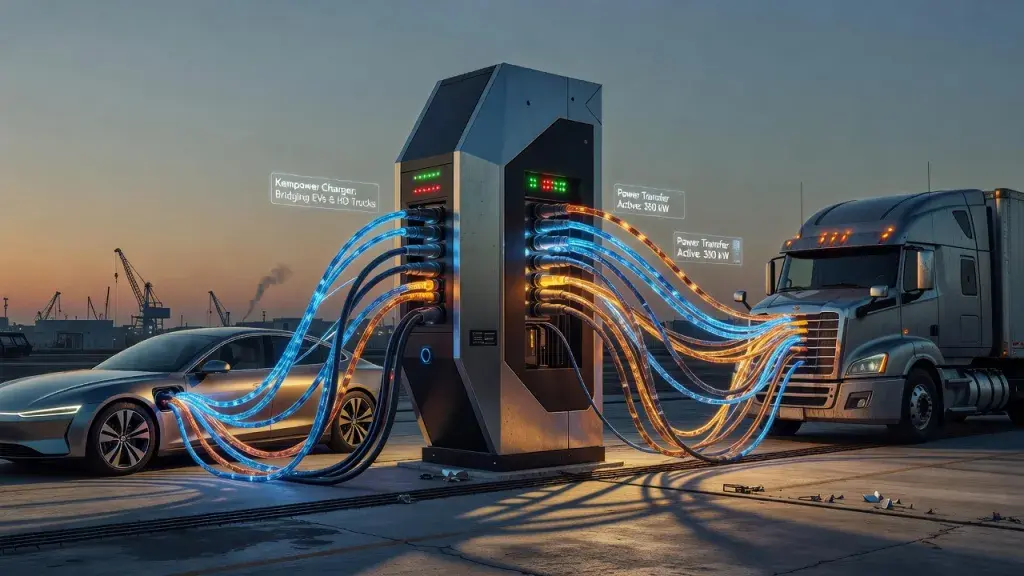
Kempower has introduced a charging unit designed to serve both electric cars and heavy-duty trucks from the same piece of hardware, a move that addresses one of the more expensive problems facing charging site operators today: building duplicate infrastructure for different vehicle classes. The new product, called the Mega Satellite Flex, supports the established CCS standard at up to 560 kW alongside the emerging Megawatt Charging System, or MCS, at up to 1.2 MW. It was revealed this week at the company's Unplug & Recharge event held alongside ACT Expo.
The timing reflects a genuine inflection point in the charging industry. CCS has been the dominant connector for passenger EVs for years, but it was never engineered for the power demands of long-haul electric trucks, which need to recharge large battery packs quickly to stay economically viable against diesel. MCS is the industry's answer, and infrastructure providers are racing to deploy it before truck fleets scale up. Elsewhere in the connectivity world, shifting technical standards and regional restrictions produce their own friction - a dynamic familiar to anyone who has looked into why some VPNs stop working in the UAE, where local rules and protocol changes can abruptly disrupt services that once functioned reliably. Charging networks face a milder but structurally similar challenge: build for the standard of today, and risk stranding assets when the standard of tomorrow arrives. why some VPNs stop working in the UAE
One Site, Two Vehicle Classes
Kempower's pitch centers on utilization. A charging site that can only serve passenger cars sits idle when a truck pulls in needing a different plug and far more power. Conversely, a site built exclusively for MCS trucks wastes capacity when demand from cars is what actually shows up during a given hour. By supporting both protocols in one unit - up to 700 amps for CCS and 1,500 amps for MCS - the Mega Satellite Flex lets an operator serve whichever vehicle arrives, rather than betting the whole site on one segment of the market. That flexibility also extends to newer 800-volt EV architectures, which need higher voltage delivery to actually realize their faster charging potential rather than being bottlenecked by older hardware.
What It Means for Operators and Fleets
Charging site economics depend heavily on how often a unit is actually in use, since the equipment itself represents a substantial upfront cost. A dispenser that can only be used by one type of vehicle inherently limits how many hours a day it earns revenue. Kempower says the dual-protocol design is meant to produce higher utilization from the outset, which shortens the payback period for site owners and reduces the need for a second, separate installation down the line as truck electrification accelerates. The unit's cable lengths - 5 meters for CCS, 2.7 meters for MCS - and its optional payment terminal suggest a design aimed at public and semi-public sites where both retail customers and commercial fleets might reasonably pull in.
Fitting Into Existing Networks
The Mega Satellite Flex is built to work with Kempower's existing distributed charging architecture, meaning operators who already run Kempower systems can add the new unit without redesigning their power distribution or control infrastructure. That compatibility matters for an industry still figuring out how much to standardize versus how much to keep flexible while MCS specifications continue to mature. The charger is expected to reach the North American and European markets in July 2026, giving site developers a defined window to plan deployments that anticipate, rather than react to, the arrival of megawatt-capable trucks.